Punk · Props · Prosthetics · Masks

The Music Work

George fronted The Mad in 1978, using foam latex and simulated disembowelment on the CBGB stage before he built masks for anyone else. He kept making his own records while building props, prosthetics and covers for other artists over the next two decades.

What He Made

The Mad · 1978

The Mad

Songwriting, vocals, and stage gore

George formed The Mad in 1978, while studying painting and illustration at the School of Visual Arts, and took the band straight onto the CBGB and Max’s Kansas City stages — the New York nightclub, the same rooms that gave the city the Ramones and the Dead Boys, not the city in Missouri the name suggests. He wrote the lyrics and composed all of his original music throughout his career; the family’s official memorial statement, published 17 August 2026, names two surviving titles from these early days, “I Hate Music” and “We Love Noize.” He sang.

It was not the first band. Talking about his stage work years later, George mentions an earlier one he calls Disgusting, and says the theatrical staging was there from the start. His rule was that the performance did not have to act out the lyric. Some words cannot be staged literally. It only had to match.

The theatrics were the point as much as the songs. Foam latex, simulated disembowelment, ritualistic stage violence — George built the effects himself and worked them into the set, night after night, on a budget that had nothing to do with a film crew. Accounts of the shows describe a woman walking on with an eyeball where her head should be, a mock abortion performed on stage with a bloody fetus prop pulled out of her, and George’s own hand-made films projected behind the band — claymation of hands pushing up out of the ground, eyeballs scooped from a skull.

Cable-access host Paul Tschinkel taped the band for his show Inner-Tube, including a set at Max’s Kansas City and a CBGB performance built around an eyeball prop for the song “Eyeball.” The surviving uploads carry no captions or usable audio transcript, and catalogues disagree between 1978 and 1979. The taping date remains open.

One song outlived the band without anyone noticing. George wrote a Mad track called “Mask”; more than a decade later he kept its music, threw out the lyrics, and wrote “Regeneration” over the top for Screaming Mad George & Psychosis.

Surviving footage: Tschinkel’s Max’s Kansas City set and its second part on Inner-Tube, the “Eyeball” performance at CBGB, and a further clip with no credited date uploaded by a fan account.
Screaming Mad George & Psychosis · 1993

Transmutation

Songwriting, vocals, and performance

George kept a band running alongside the film work. Screaming Mad George & Psychosis was three people. He sang, wrote and performed. A collaborator he calls a mechanical genius — brilliant at industrial music, with a band of his own — came in after George pitched the project during a conversation. The name survives only as a garbled Japanese caption, so this page will not guess at it.

The third was a woman named Lisa. She was not a singer. George needed a female voice for the concept and asked a makeup-artist friend whether she knew anyone; she said she could do it herself. He did not believe her, made her sing something on the spot, and hired her. George later described the three-person collaboration as intense and its live show as unusual.

The songs came first, around 1990, because the point was to make a record. “Regeneration” is the exception, and the exception connects two halves of his life: the music is an old song called “Mask” from The Mad, his New York punk band. He stripped out the original lyrics and wrote new ones over the same music — backwards from his usual habit of writing words first and composing to fit them.

George describes The Mad as being about madness, and Psychosis as being about psychological analysis and transformation rather than destruction. He names Dadaism, Surrealism and Futurism as movements deliberately worked into the songs, for whoever recognises them.

The band played EXTASY SUMMIT ‘92 at Nippon Budokan on 30 October 1992, on a ten-act bill for Yoshiki’s Extasy Records, and did three songs. The first single was 「パラノイアスケープ」(Paranoiascape), Extasy Records EXS-002, November 1992, backed with “Dried Up Scream.” Its artwork — the skull screaming inside flames that opens the live footage — is Munch’s The Scream, cracked and decayed down to bone. The album Transmutation followed on Extasy, EXC-012, 10 June 1993, eleven tracks: Birth, Paranoiascape (V2.1), Dried-Up Scream, Anxiety Neurosis I (trauma talk), Anxiety Neurosis II, Regeneration, Bacterium, Hope, Persecution Mania, Catastrophic Dream, Transmutation.

What he wore, and why it moved like that

The stage costume was a brass creature head — sheet metal drilled through and shaped by hand — rooted to a corrugated water pipe that ran down his spine into a tail, with a thick aluminium bar for ribs screwed on and fitted to his own body. The mouth sat where a microphone could be pushed into it, so he sang through the creature rather than around it. He compares the look to H.R. Giger: metal and organic matter fused.

The arm extensions came from the Bauhaus — the school, not the band, as he is careful to say. He had seen photographs of Oskar Schlemmer’s costume performances, one built around poles strapped along the performer’s arms so that shifting them changed the whole silhouette. A long pole would have wrecked a club stage, so he built stacked false hands instead: hold the arm straight and there is one hand, bend it and there are six.

He had been doing this from the beginning. Before The Mad there was a band he calls Disgusting, and he says the theatrical staging was there from the first. His staging matched a lyric without having to illustrate it literally.

His music and effects work overlapped again when he designed and directed Screaming Mad George’s Paranoiascape for the PlayStation in 1998. He wrote its music as well; the game takes its name and its theme from the band’s own 1992 single, six years earlier.

George’s account of this period survives through automatically generated Japanese captions on video he made with his daughter Alice. It is paraphrased here, and names that the captions garble have been omitted.

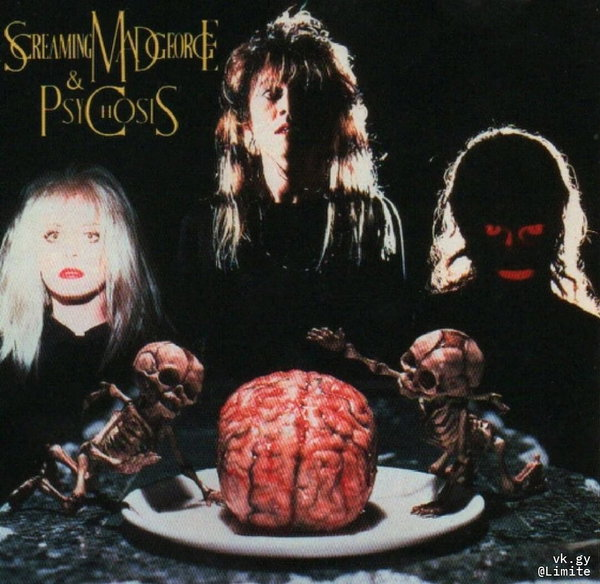
Screaming Mad George & Psychosis artwork: three band members behind a brain served on a plate flanked by two small skeletal figures.
Screaming Mad George & Psychosis — Songwriting, vocals, and performance Credit: Extasy Records - release artwork. Scan watermarked vk.gy

Screaming Mad George with THE GEROS · 2019

One Night at Namba Bears

Vocals — The Mad, played again

On 9 November 2019, at 難波ベアーズ (Namba Bears) — a small basement live house in Osaka — George got up and sang. The band behind him was THE GEROS, and the set was The Mad: his own songs from New York in 1978, played again four decades later.

THE GEROS are an Osaka punk trio who formed around 2014. George appeared with them as a guest for this one set. Their records include a 2014 demo, a Genocide or Suicide 7” on Killer Boy Records in 2015, a Razor Dog 7” on an American label in 2017, and a remastered collection out of Malaysia in 2023. Their line-up is ANGEL on guitar and vocals, SHOOTER on bass and TA/CO on drums.

His own site is precise about what happened: 「マッド・ジョージのバンド “The MAD” カバーに本人登場!」 — Mad George himself turns up to cover his own band, The MAD. One night, as a guest, singing songs he had written in 1978 with a younger Osaka band.

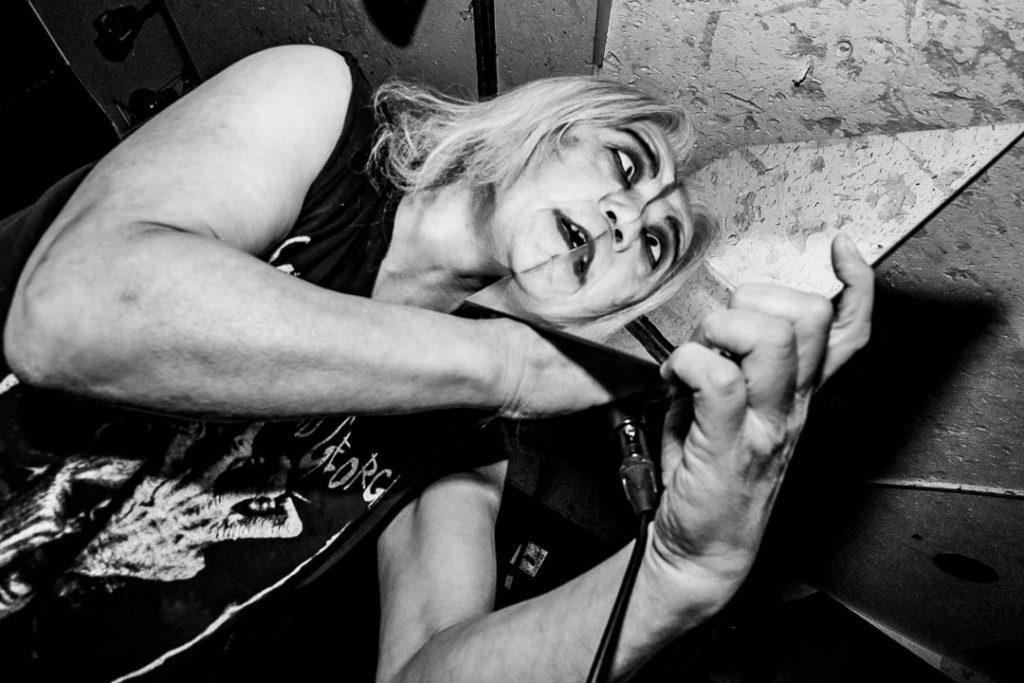
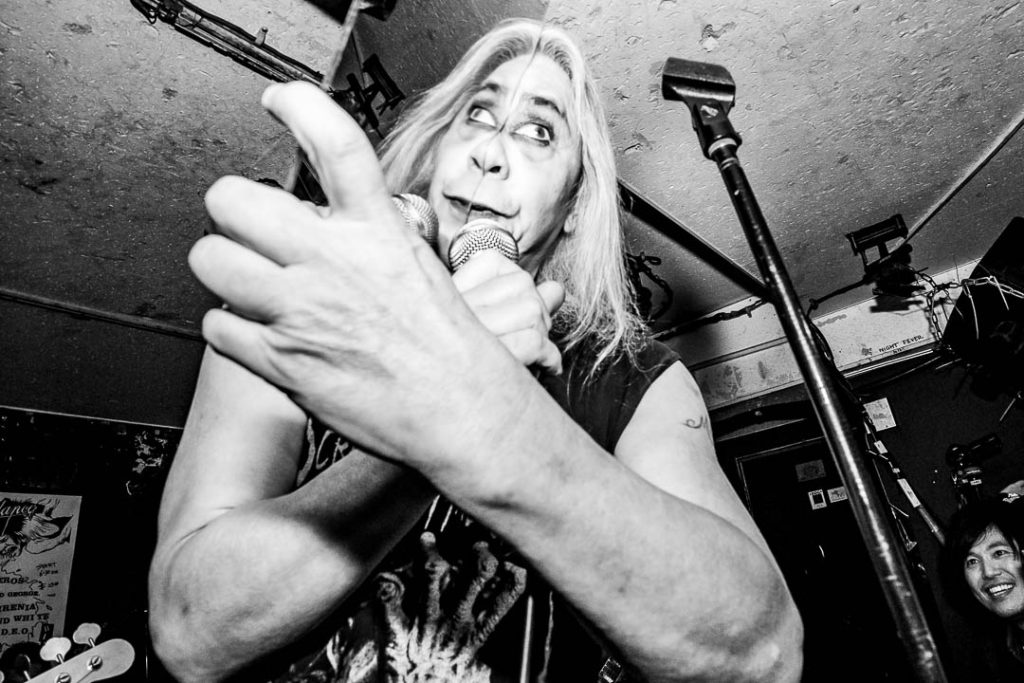
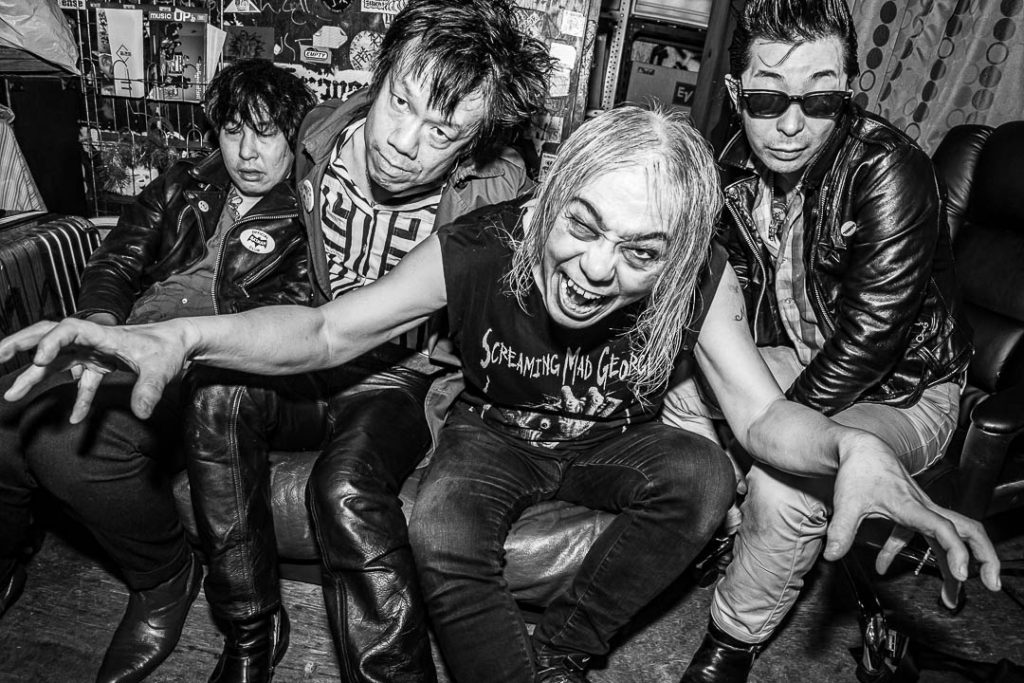
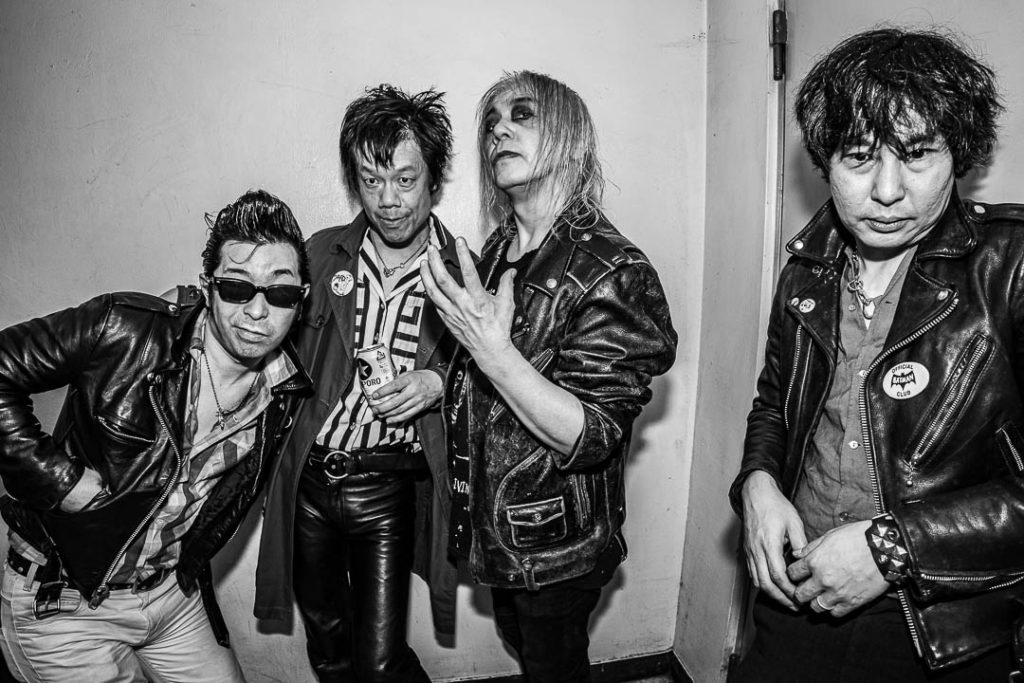
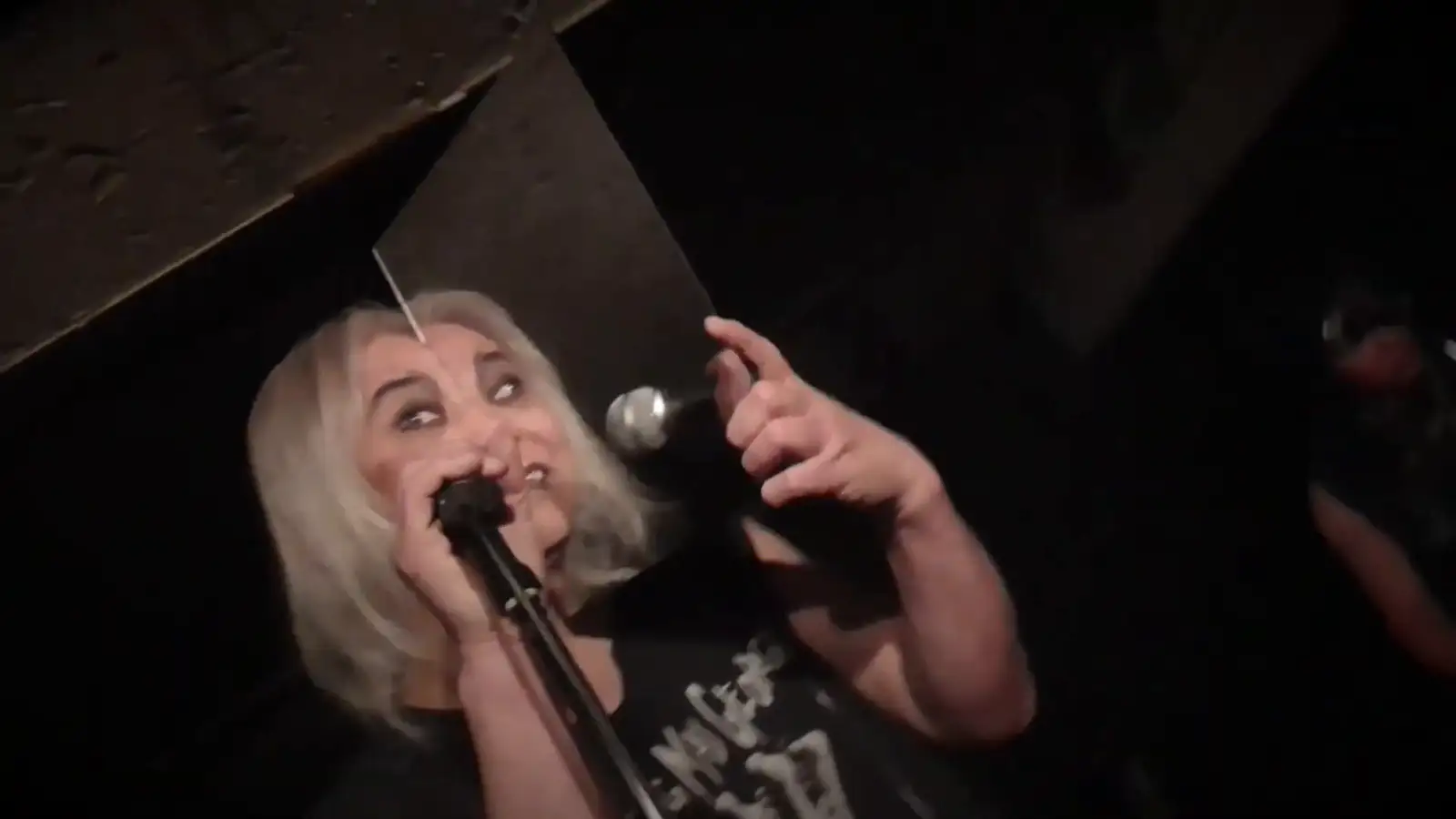
Teppei Miki photographed it, and his pictures are the record of the evening: George white-haired and barefoot on a low stage, shirt printed with his own name and hanging off the microphone stand, the room close enough that phones are held up at arm’s length from his face. Afterwards the four of them sat for portraits in the dressing room, George grinning open-mouthed in the middle of three men in leather.

Photographs by Teppei Miki, credited on both his own site and George’s. Video of the night exists as a short cut on YouTube, linked from George’s official movie page.

Screaming Mad George with THE GEROS — Vocals — The Mad, played again
Black-and-white shot of Screaming Mad George mid-performance, white hair loose, gripping a microphone cable and shouting, shot from a low angle in a small venue.
Screaming Mad George with THE GEROS — Vocals — The Mad, played again Credit: Photo by Teppei Miki; official Screaming Mad George gallery
Black-and-white shot of Screaming Mad George singing into a handheld microphone with one arm thrust toward the camera in a low-ceilinged club.
Screaming Mad George with THE GEROS — Vocals — The Mad, played again Credit: Photo by Teppei Miki; official Screaming Mad George gallery
Black-and-white group photo: Screaming Mad George, in a shirt printed with his own name, grins open-mouthed on a couch with three bandmates in leather jackets.
Screaming Mad George with THE GEROS — Vocals — The Mad, played again Credit: Photo by Teppei Miki; official Screaming Mad George gallery
Black-and-white group photo of Screaming Mad George and three bandmates standing against a white backstage wall in leather jackets.
Screaming Mad George with THE GEROS — Vocals — The Mad, played again Credit: Photo by Teppei Miki; official Screaming Mad George gallery

What He Made For Other Artists

X Japan · 1991

Jealousy

Album cover concept & Tokyo Dome stage design

Jealousy is the X album whose cover shows Yoshiki bound and chained, his body wrapped in extra arms. George describes the job himself, on camera, in a retrospective he filmed with his daughter Alice. His official portfolio, the album credits and Yoshiki’s memorial tribute corroborate the credit.

He recalled that he did not know what kind of band X was when the work came in, so he went and looked them up in magazines. He designed the image, and then he built it: the block wall behind Yoshiki, the rigging the chains hung from, the whole set. He remembers being struck that Yoshiki turned up exactly on time.

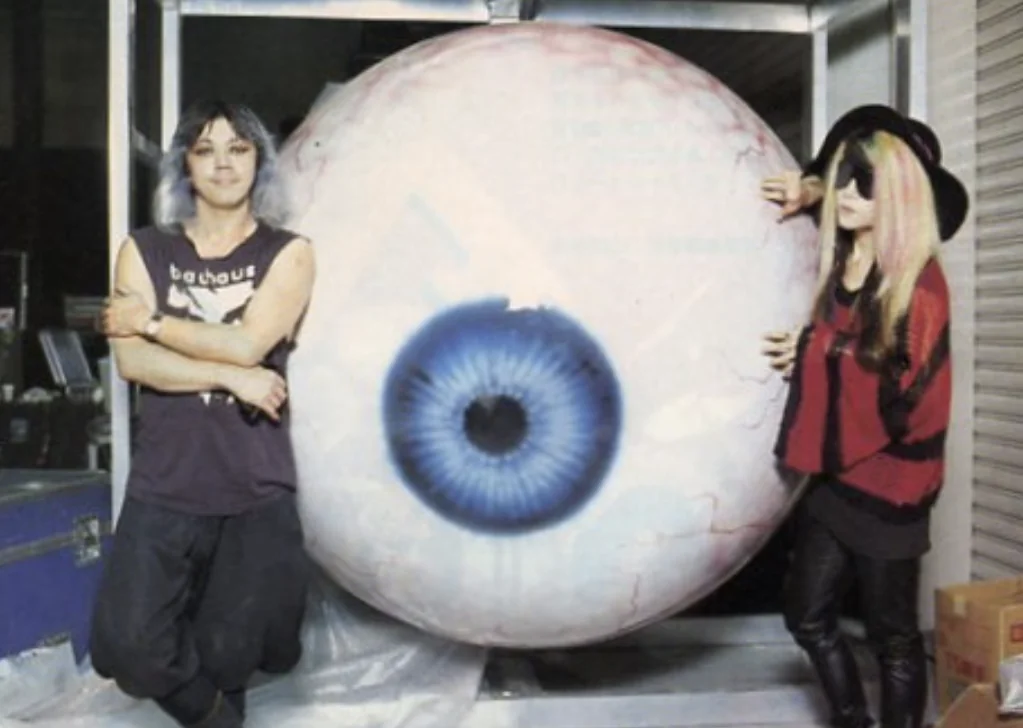
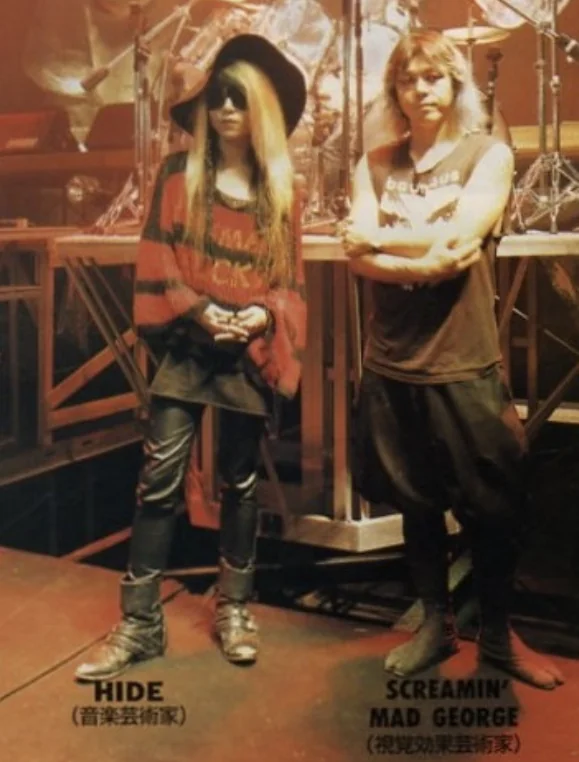
This is also where he met hide, who had no reason to be at the shoot and came to watch anyway. Everything that followed between them — the Hide Your Face mask, the magazine cover, a music video full of live cockroaches — started in that room.

The year after, X gave him the stage. For the Jealousy dome tour he designed four huge faces, one per member, rising over the set, with a mass of eyeballs in the middle. Building four complete faces turned out to be more than the schedule allowed, so each one only came halfway out from behind a curtain — enough, with all four up at once, to fill the dome.

His own site lists both jobs plainly: 「X アルバム/Jealousy ジャケット・東京ドームステージデザイン」 — Jealousy jacket, and Tokyo Dome stage design. The album’s own credits name him for the front cover concept alongside Yoshiki, and for mask and makeup. When George died, Yoshiki’s tribute named the Jealousy artwork too.

George’s account survives through an automatically generated Japanese caption track, so it is paraphrased here rather than quoted.

The organic-metal piping in this site’s ornaments was drawn from that cover.

Screaming Mad George and hide stand on either side of a giant eyeball stage prop in a loading bay.
X Japan — Album cover concept & Tokyo Dome stage design Credit: Magazine scan; reproduced in Screaming Mad George's official portfolio
hide and Screaming Mad George stand together on a concert stage set, each labelled beneath in Japanese as music artist and visual effects artist.
X Japan — Album cover concept & Tokyo Dome stage design Credit: Magazine scan; reproduced in Screaming Mad George's official portfolio

hide · 1994

Hide Your Face

The third-eye alien mask

George met hide (Hideto Matsumoto) at the Jealousy cover shoot in 1991. hide had no working reason to be there and turned up to watch anyway. George, who had looked the band up in magazines before the job, had already picked him out as the one doing the strangest things.

For hide’s solo debut he wanted to disappear behind a mask so the music spoke first. He was a Giger admirer and hoped to commission an original piece, but Giger was unavailable; instead he was allowed to use an existing 1993 aluminium sculpture, The Watch Guardian V, and brought it to George to turn into something a person could actually wear. George’s own site records the job in five words — 「ヒデ アルバムカバー ギーガーデザインマスク」, hide, album cover, Giger-design mask.

George and collaborator Joanne Bloomfield built it at his Los Angeles studio in fiberglass and foam latex rather than Giger’s heavy aluminium, and made two versions: a detailed one for the album photography, and a wider, reinforced one light enough for the stage. hide wore the stage version during the opening of “DICE” at Yokohama Arena in April 1994, standing still under the third eye before pulling it off mid-song. The mask went into the hide MUSEUM in Yokosuka after his death in 1998 and has toured Japan in memorial exhibitions since — the third eye is this site’s logo for that reason.

Two heads on a tray

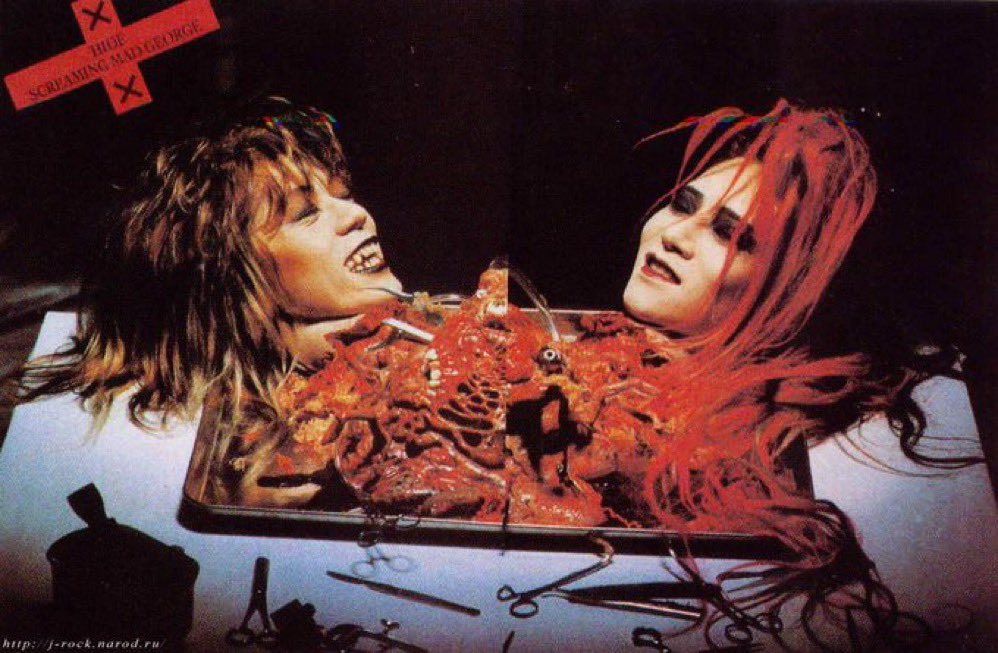
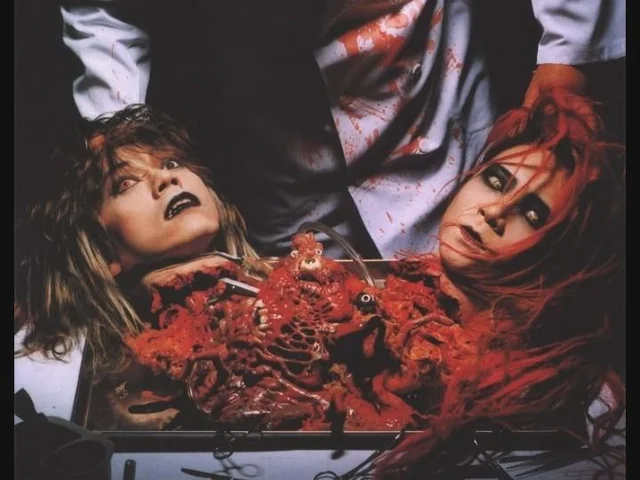
The friendship produced stranger things than the mask. FOOL’S MATE ran an interview between the two of them, then asked George to shoot the cover as well. George recalled that once he was involved, the concept had to be something crazy: the two of them as severed heads on a table, grinning at each other, their organs spilling across the tray between them. They cut a hole in the table, put their faces through it, and wore torn-neck appliances to hide the join.

The magazine was not sure it could print it. Something anatomical was visible in the mass of organs, so the cover logo was positioned directly over it — a censor bar doing double duty as branding. Inside, each of them got a solo severed-head portrait. Back-issue listings put it at No. 136, February 1993. The often-repeated story that Sugizo of LUNA SEA wandered in and was startled has no source behind it at all, and is not repeated here.

The cockroaches

For a hide music video, George built a flying-saucer drum-kit prop for a crew descending in spacesuits. Then the director asked for live cockroaches stuck to hide’s bare torso. George offered to make fakes — he had built a cockroach transformation for A Nightmare on Elm Street 4 and had no wish to handle real ones — but the director insisted on real ones. He settled on 水飴, thick starch syrup, as the adhesive: coat the skin, lay each roach wings-down with its legs facing forward, press, repeat. They went on hide’s face too.

Once filming started the director asked hide to put one in his mouth, and he did. George found out afterwards why hide had refused the prosthetic version: he had been offered a choice between vomiting fake blood on camera or wearing the roaches, and flatly refused the vomit. George called hide incredible.

George’s account of the magazine shoot and the video survives through automatically generated Japanese captions. It is paraphrased here, and names that the captions garble have been omitted.

hide and Screaming Mad George appear as two severed heads on a metal tray joined by organs, with a red X logo printed over the centre.
hide — The third-eye alien mask Credit: FOOL'S MATE (Fool's Mate) No. 136, February 1993; photographer uncredited. Scan watermarked j-rock.narod.ru
A closer view of the two severed-head prosthetics on the tray, with a figure in a bloodied lab coat standing behind them.
hide — The third-eye alien mask Credit: FOOL'S MATE No. 136, February 1993; photographer uncredited
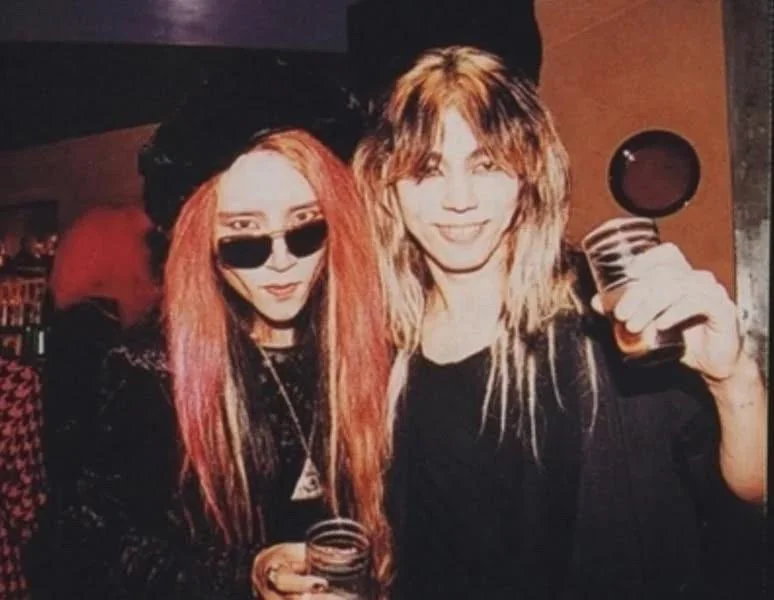
hide, in sunglasses and red hair, stands with Screaming Mad George at a bar, both holding drinks.
hide — The third-eye alien mask Credit: Owner-supplied scan; public copy via r/visualkei; photographer and original magazine untraced
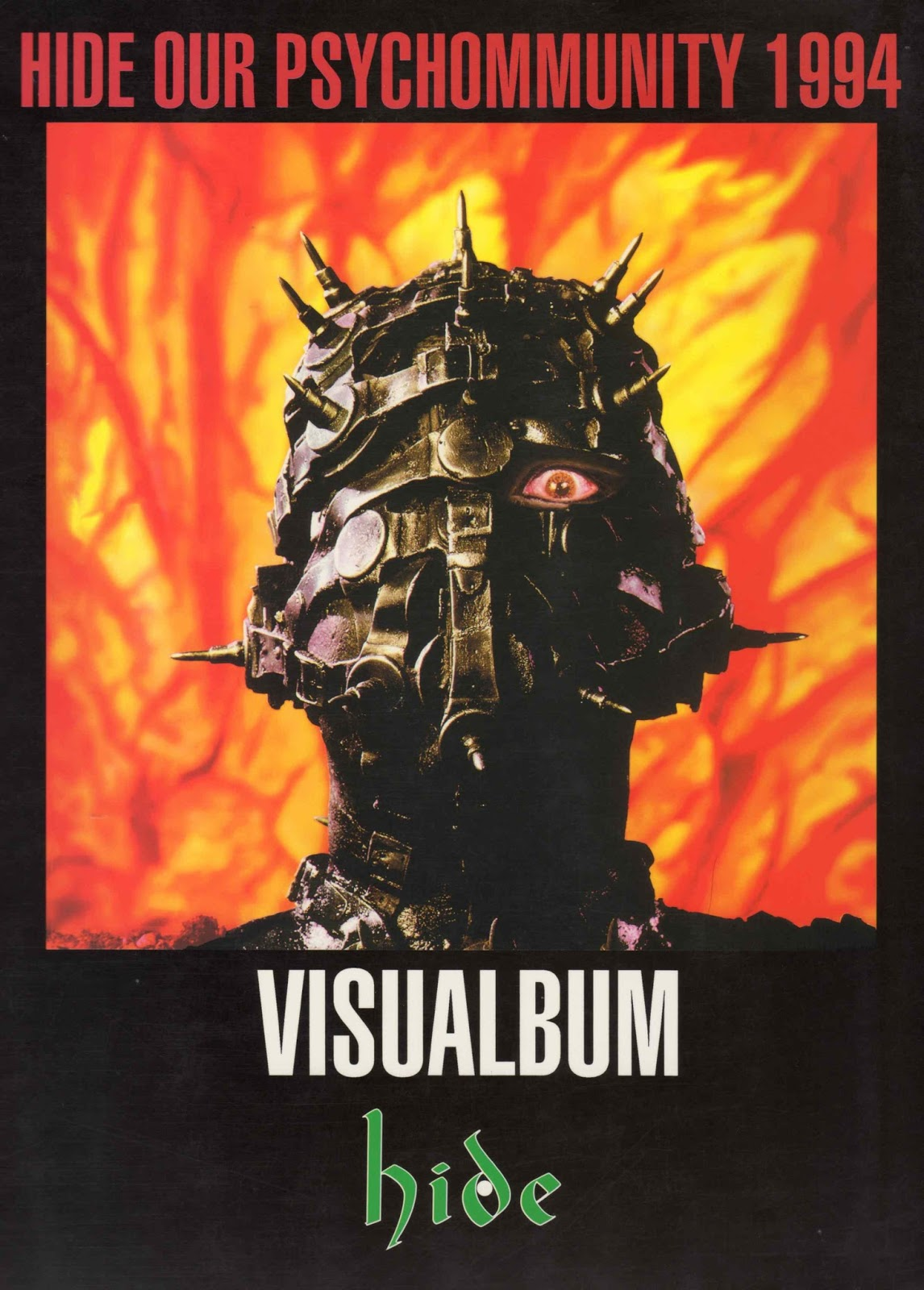
Cover of hide OUR PSYCHOMMUNITY 1994 VISUALBUM, showing spiked metallic head-and-shoulder armour with one exposed red eye against a flame background.
hide — related release artwork; maker unconfirmed and not attributed to Screaming Mad George Credit: hide OUR PSYCHOMMUNITY 1994 VISUALBUM; maker of the armour unconfirmed
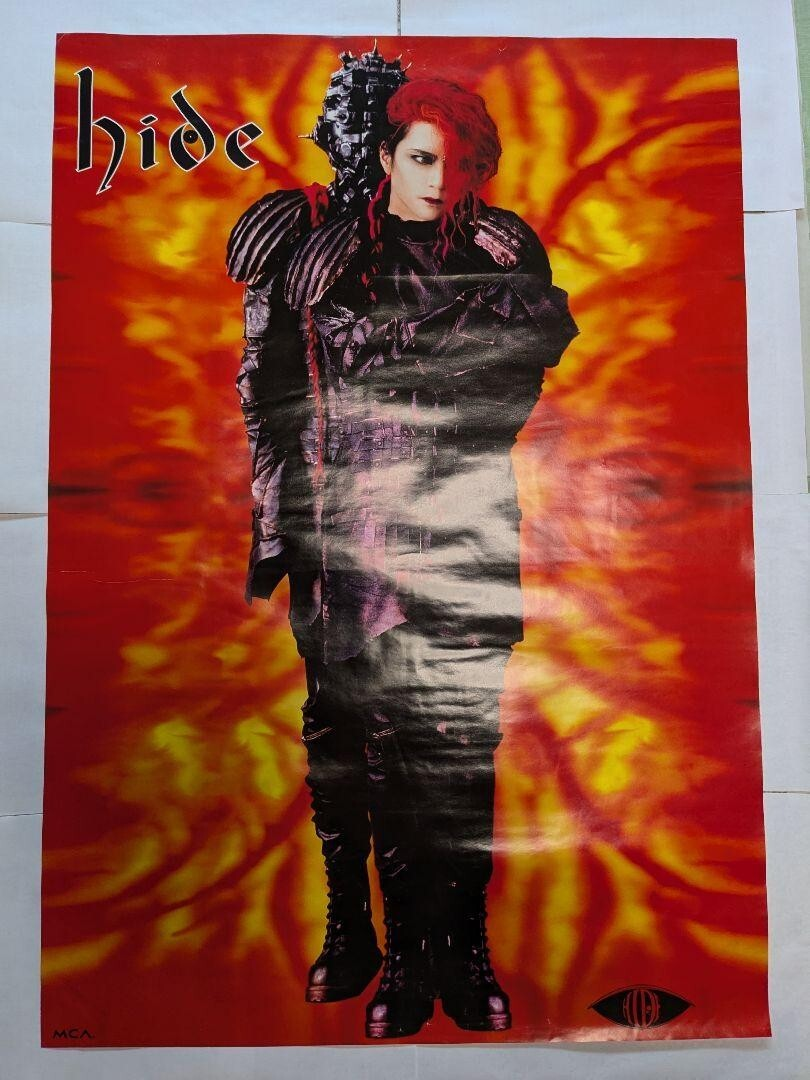
1994 Japanese Hide Your Face promotional poster showing hide in red hair beside a figure in spiked metallic armour against a flame background.
hide — related release artwork; maker unconfirmed and not attributed to Screaming Mad George Credit: 1994 Hide Your Face original B2 record-release promotion poster; designer and armour maker unconfirmed

Nine Inch Nails · 1994

Closer

The mechanical beating heart

George said it himself in Heather Wixson’s published interview: “I did the beating heart at the beginning of Nine Inch Nails’ Closer video.”

The video shows the heart held in a metal frame, its tubing exposed and its movement timed to the beat. The surviving public sources confirm George’s credit but do not document the mechanism or materials, so this page does not guess at either. nin.wiki’s video credits independently name him as the artist who created it.

Nine Inch Nails — The mechanical beating heart
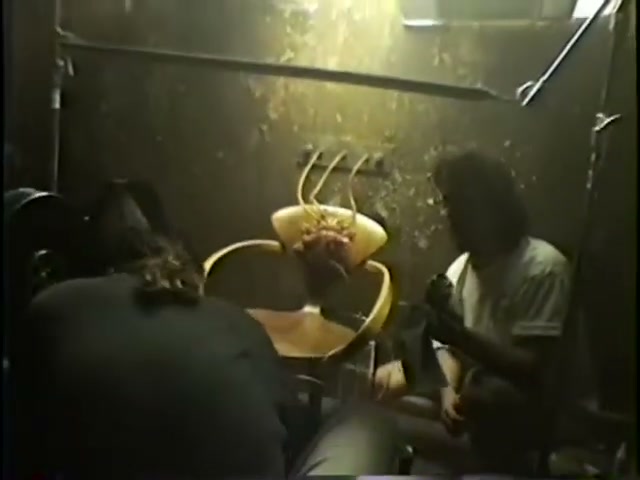
Two crew members work on the mechanical heart prop mounted on a wooden chair on the Closer set.
Nine Inch Nails — The mechanical beating heart Credit: Frame at 17:46 from The Making Of Closer; linked copy is a third-party upload
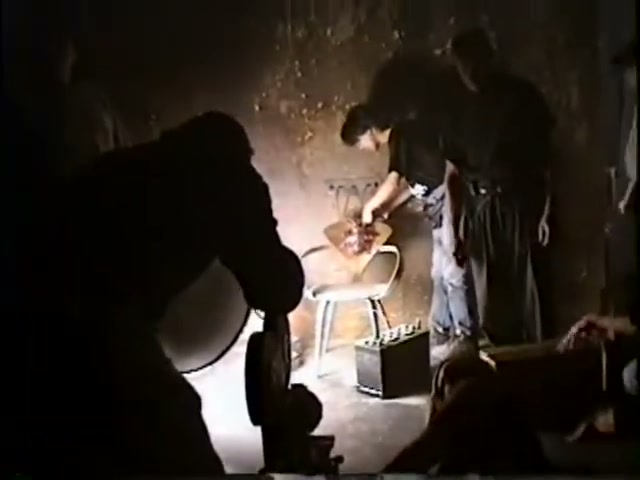
A wider view of the Closer set as crew rig the heart prop on the chair under a work light.
Nine Inch Nails — The mechanical beating heart Credit: Frame at 17:51 from The Making Of Closer; linked copy is a third-party upload
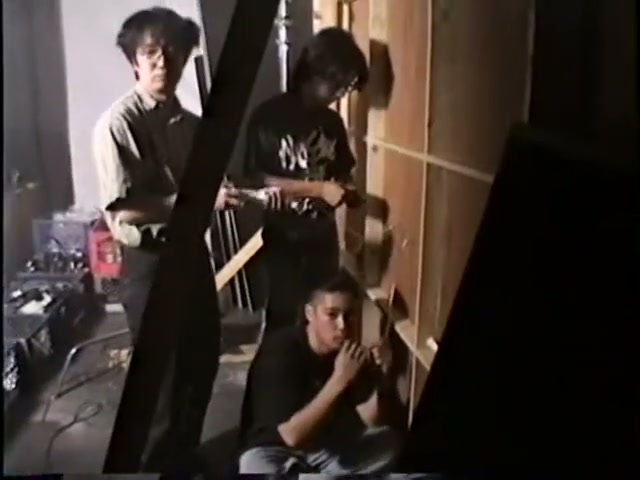
Three crew members work behind the Closer set wall, one operating control rods by hand.
Nine Inch Nails — The mechanical beating heart Credit: Frame at 18:17 from The Making Of Closer; linked copy is a third-party upload

Marilyn Manson · 1998

Mechanical Animals / The Dope Show

The androgynous silicone body suit

Manson and photographer Joseph Cultice conceived the Omega persona as sterile and sexless, closer to Bowie’s alien in The Man Who Fell to Earth than to anything human. They came to George’s San Fernando Valley studio, and George sculpted the chest plate from his own imagination rather than casting it from a model — a silicone piece with sculpted breasts.

The label pushed back. Nothing/Interscope worried the nipples on George’s original sculpt would keep the album out of Walmart, so Manson and Cultice went back to the studio and had them smoothed off. Walmart banned the record anyway. The finished chest plate appears on the cover, airbrushed under white liquid latex to erase the seams, and again in motion in Paul Hunter’s “The Dope Show” video and at the 1998 MTV Video Music Awards, where Manson performed in it live.

Marilyn Manson — The androgynous silicone body suit

NSYNC · 2000

It's Gonna Be Me

Marionette-doll prosthetics

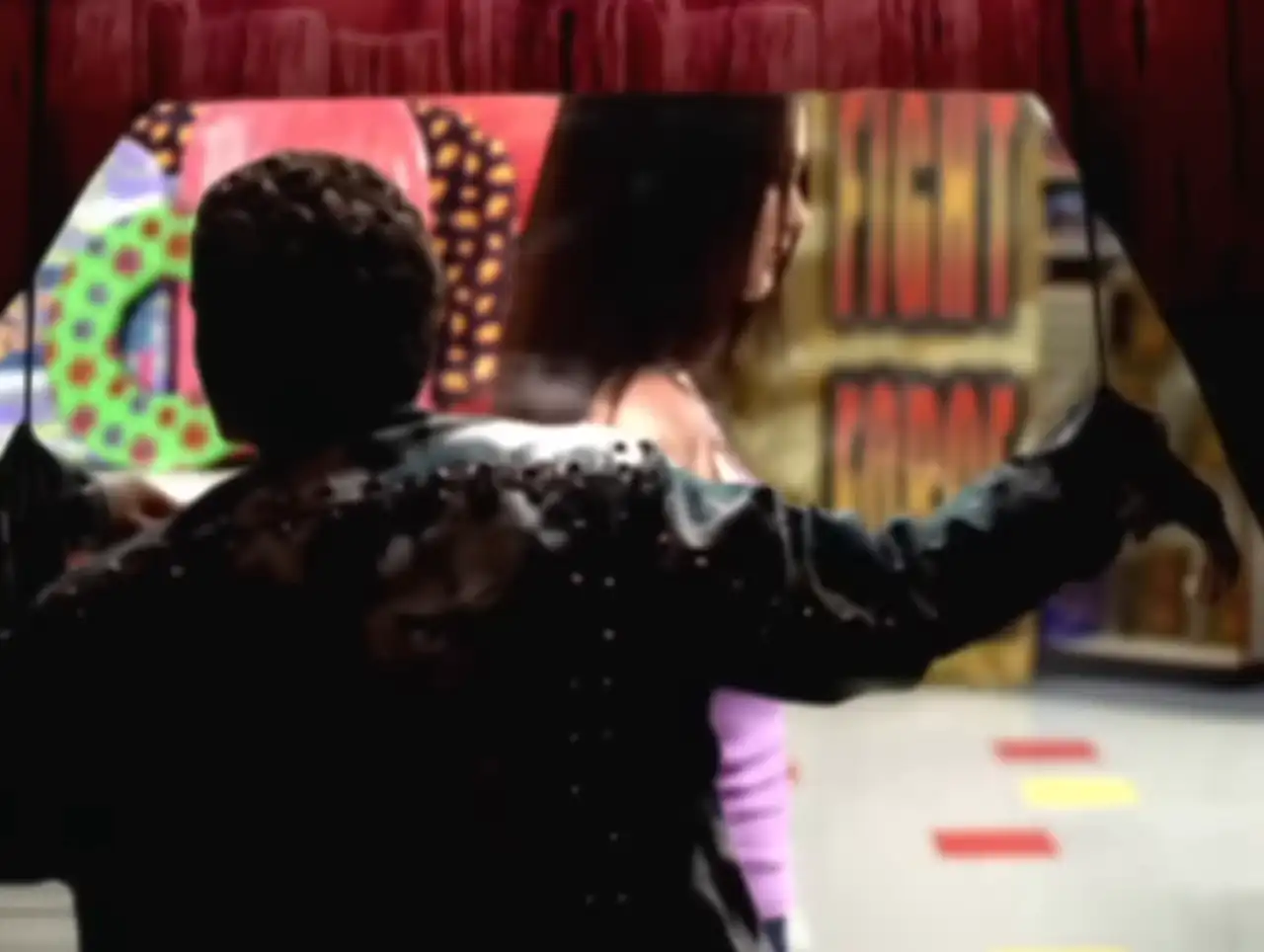
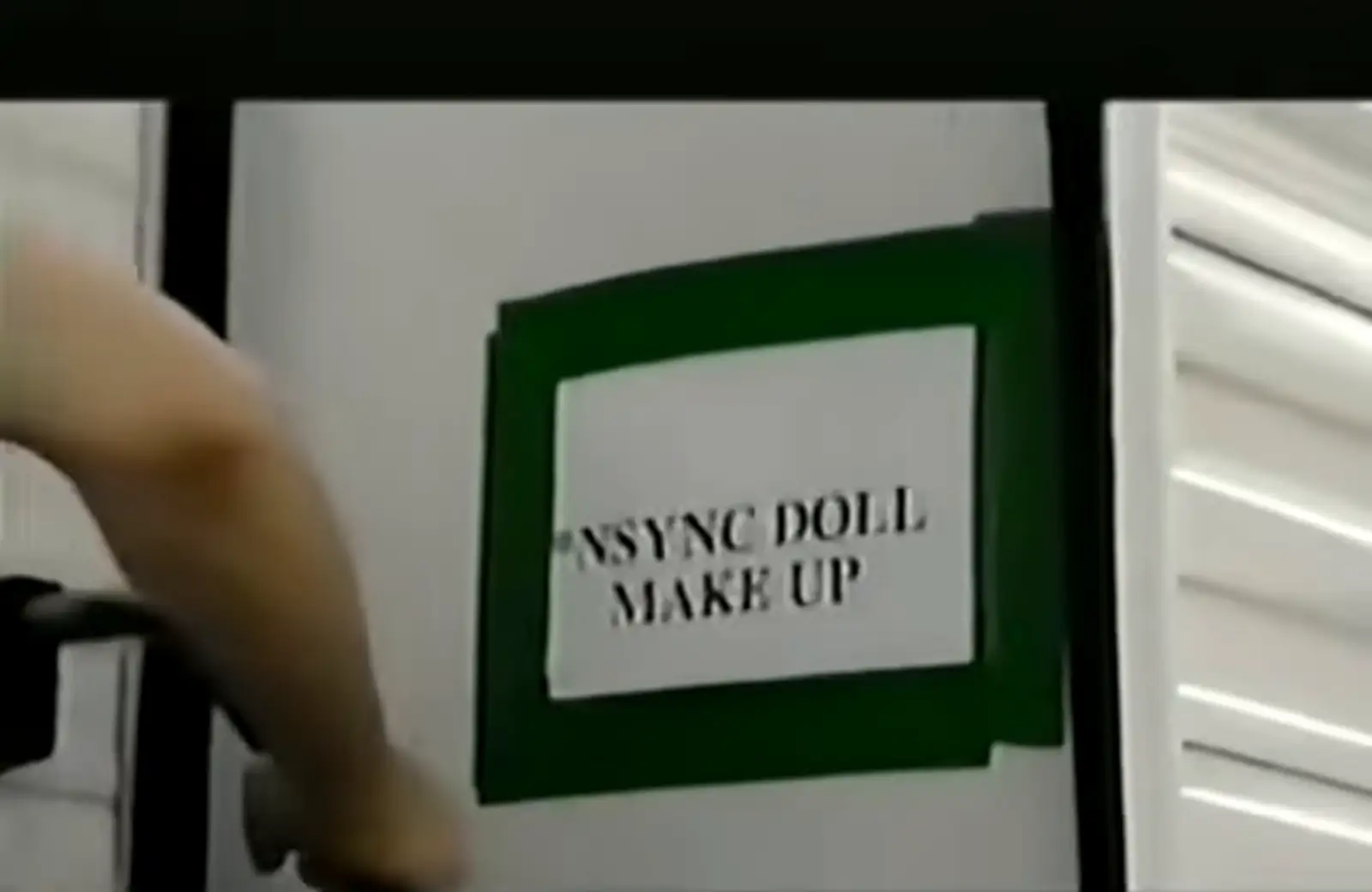
Wayne Isham needed all five members of NSYNC turned into dolls. He went to a CGI house first; they told him the schedule was impossible. So the dolls were built on the performers instead, and George’s shop did the building.

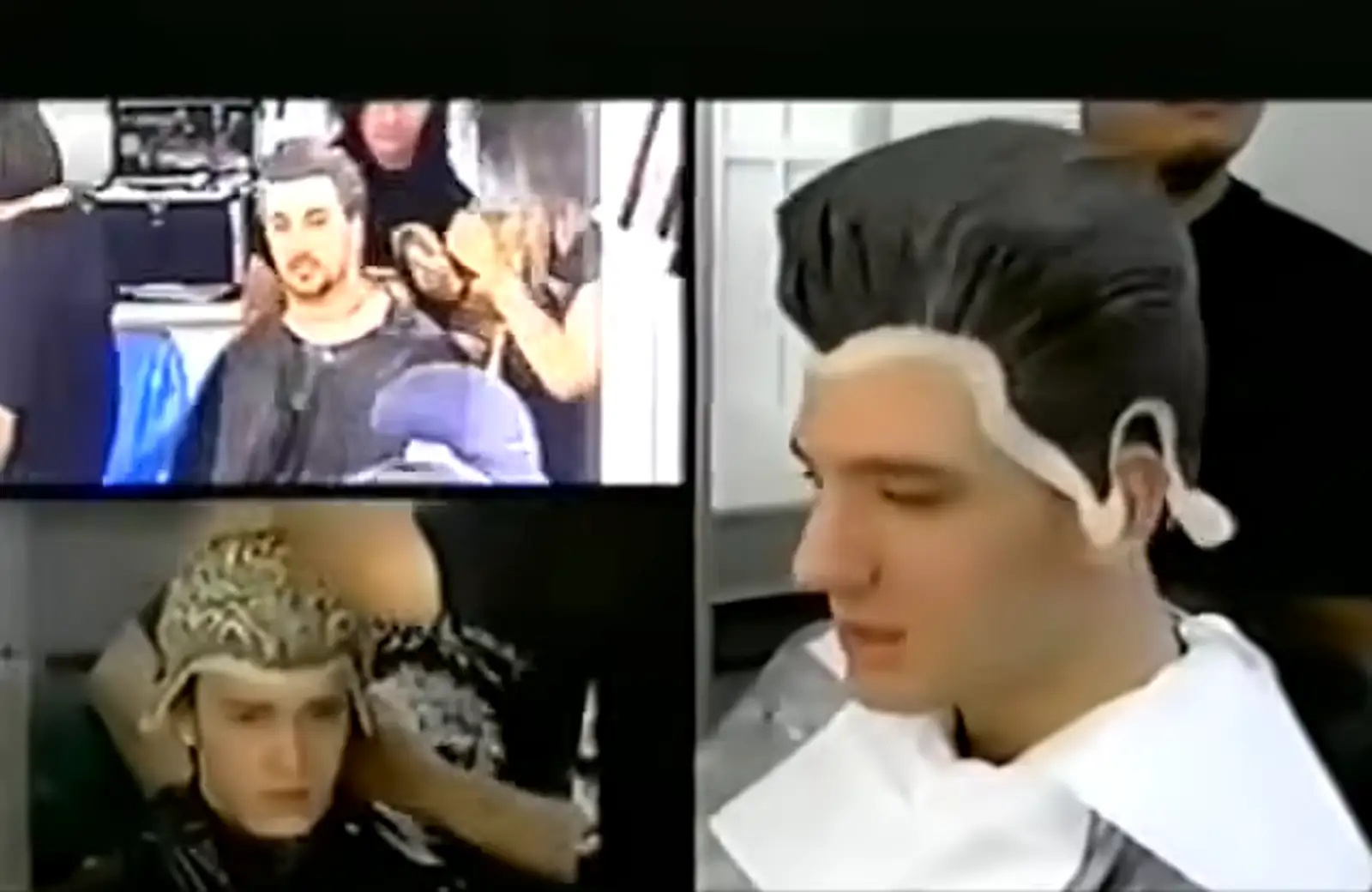
The surviving record documents prosthetic makeup, prosthetic eyebrows and facial hair, and doll hair fitted over the scalp. It does not establish the materials or the construction of the visible doll joints.

Each member spent six hours in the chair. The band then stayed in the makeup for a full twenty-four hours, twenty-two of them shooting. Joey Fatone remembers a seven in the morning call and getting the pieces taken off at seven the next morning, and wanting to claw the prosthetics off by the end. It was shot over three days in late April 2000 at Los Angeles Center Studios, on a toy-store set built seven times oversized, scaling five grown men down to action figures on a shelf.

Isham shot the choreography at twelve frames a second and played it back at twenty-four, so the dolls move with a stop-motion stutter on top of the makeup. It won Best Makeup at the 2001 MVPA Awards. The doll-in-a-box image returns every year with the “It’s Gonna Be May” meme.

NSYNC — Marionette-doll prosthetics

Slipknot · 2001

Iowa & Vol. 3 Masks

Mask design & fabrication

Slipknot’s 1999 debut was built from found and modified masks rather than sculpted effects work — Shawn Crahan’s clown, a pig mask Anders Colsefni found and padlocked, Corey Taylor’s crash-test dummy turned inside out with his dreadlocks pulled through the holes. None of that was George’s.

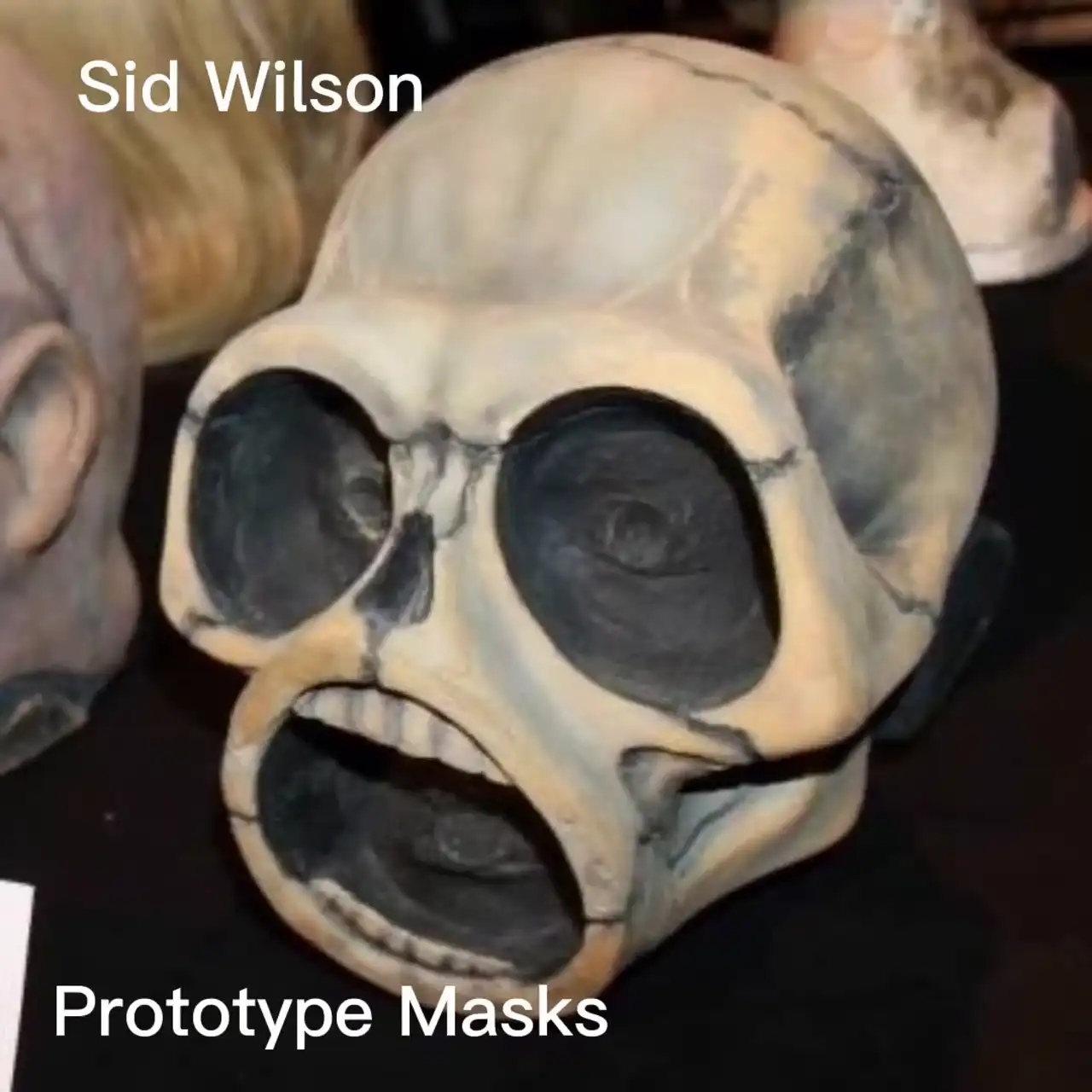
He came in for Iowa in 2001, and Taylor has since drawn the boundaries of the whole relationship in one sentence: George “did the masks for us, for Iowa, Volume 3, he did a little work with us on All Hope Is Gone.” His documented involvement therefore spans 2001 to 2008, although Taylor describes the All Hope Is Gone work only as “a little.” Tom Savini took over for the masks that followed a decade later.

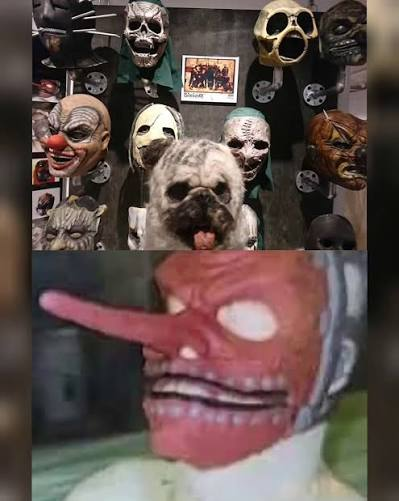
The lifecasting session — every member cast, masks sculpted over the casts, the first time the things actually fit the faces underneath — belongs to Vol. 3 in 2004, not Iowa. Through the Iowa era some members were still wearing their 1999 masks. The long-nosed Pinocchio mask associated with Chris Fehn is usually given a seven-and-a-half-inch nose.

For Vol. 3 in 2004, Taylor’s mask came out of that process — a mangled face with burnt, stitched skin, nicknamed the football mask for the seams, and by Taylor’s own account the hardest of his masks to sing in because it was asymmetric.

Photographs from George’s exhibitions show Slipknot masks displayed as his. One carries a museum card that specifically documents his prototype for Mick Thomson: “MICK’S TEST MASK PROTOTYPE MADE BY ‘SCREAMING MAD GEORGE’ — THIS MASK EVENTUALLY BECAME MICK’S SIGNATURE MASK.”

The stitching on this site’s section dividers is a nod to the Vol. 3 mask.

Slipknot — Mask design & fabrication
Two stacked photographs: a display case of Slipknot masks around a band photo, and below it a close-up of the long-nosed Pinocchio mask.
Slipknot — Mask design & fabrication Credit: Via David Hayat / @drh_theametal; original exhibition photographer unidentified
Screaming Mad George, grey-haired, leans in at the side of a lit display case holding around ten Slipknot masks.
Slipknot — Mask design & fabrication Credit: Via David Hayat / @drh_theametal; original exhibition photographer unidentified